


Showing posts with label library project. Show all posts
Showing posts with label library project. Show all posts
Thursday, October 6, 2011
All About Explorers
Now that the initial website reliability (or lack thereof) lesson is completed, I can share with you about our "All About Explorers" Project that fifth graders are completing. This summer, I attended the ISTE conference in Philadelphia and was fortunate to sit in on a presentation given by a SLMS from Centennial School District and a principal from Cheltenham School District. They collaborated to create a series of lessons called "All About Explorers". They developed a website with a webquest for groups of students to complete about different explorers with information from real and reliable websites and one not-so-real website. The entire point of the assignment is for students to compare the information and realize that the facts don't match up. You'd be amazed how many students wrote down an answer just to write down an answer, even if they DID realize that the two sites had conflicting information. Our next two lessons will follow up with All About Explorers and how to find REALLY reliable information on the web and in books as well. This project worked so well for this group because Explorers are a part of the Social Studies curriculum and I asked that it be on the front end of the year so that I could streamline this project in and students would come to class with some prior knowledge. This is a powerful lesson as students realize that it's near (no, it is) impossible that Columbus was born in 1942 if he sailed the ocean blue in 1492. And, how often they go with the site that "looks good." Together, we'll find the sites that ARE good.

Monday, February 14, 2011
Strike a Pose
Third graders will be doing just that soon, following their biography wax museum project. We introduced biography right after winter break, discussing the project for language arts classes and the famous people that students remembered seeing in last year's wax museum. I discussed where the biography section was in our school library, how to search using the catalog, and how to best utilize the public library if a book was unavailable in our school. During the following class, we looked at Jerry Pinkney's work, wrapping up our unit on fables, and reviewing tall tales, and we looked at Brian Pinkney's biography: Happy Birthday, Martin Luther King. We also looked at how to search for more reading material on their selected person on reliable websites. During the next class, I introduced the online encyclopedia as a tool for more information AND as a tool to create timelines for the selected person's life. Following that, we elaborated more on biographies of famous slaves during the time of the underground railroad; focusing on two Caldecott honor books from illustrator Kadir Nelson: "Henry's Freedom Box" and "Moses", a story of Harriet Tubman. Next up is a lesson in preparation of Read Across America, a celebration of Dr. Seuss' birthday on March 2nd. Naturally, in keeping with the biography unit, we will discuss "The Boy on Fairfield Street", a biography of Dr. Seuss. From there, we will begin to look at the third grade centric books of our visiting author, Debbie Dadey, whose visit is quickly approaching April 2nd. Time sure does fly when you're having fun!
Monday, January 31, 2011
Use Your Noodle
Fourth and Fifth graders in our school have just completed informational writing pieces AND bibliographies! Students learned the importance of giving credit to their resources and how EASY it can be to do so. In the process of teaching this unit and pulling my hair out a little, I learned about Noodle Tools, which I WISH had existed when I was doing research papers in high school, college, and grad school. Noodle Tools MLA Easy Bib starter was designed for students in grades 1-5 and does not require an email address to make an account. We tried for a uniform logon and password to match the school accounts but this did not work for all and making accounts and remembering the personal IDs and passwords proved to be the most difficult step to using Noodle Tools. Actually creating citations was easy peasy. And the process of entering the information helped students to learn how to look for the publisher and copyright year for a book, the author of a website and what constitutes the title of an article and the importance of utilizing a variety of different sources. Students also learned what great print resources we have both in our school library and available through the public library consortium as well as how to access our subscription based online encyclopedia. All of this was completed through a hands on assignment tailored to an existing classroom assignment. In an effort to improve this project for future classes, I solicited feedback from each class through a survey/form on google docs thereby giving students the opportunity to give genuine and honest feedback. So far it has been very positive and I'm happy with the growth I have seen in the student's information literac as a result of this project.
Saturday, January 15, 2011
The Dewey Challenge
Third graders spent the first quarter of the school year learning about the Dewey Decimal system. While some may think it is outdated or unnecessary to learn, it is truly an inspired and ingenious method of organization. Every book has a home. Some people advocate for an organization more similar to a bookstore with topical headings - all the sports books over here and all of the science books over here. News flash! The DDS, not to be confused with DDR, DOES organize books by subject and even mine down further than that, grouping all the animals together and one step further all the mammals together and one step further all of the dolphins together and if you want to get really specific all the dolphin habitat books together. But I digress. In an effort to arm students with the skills they need to independently AND efficiently find materials in the library, they DID learn what the DDS is, how Dewey came up with it and why. They practiced grouping actual books together and are now undertaking the Dewey Challenge. It is relatively simple in concept. I created two sided bookmarks with spaces for students to fill in the titles of one book from each number section as well as one from fiction, picture books, and biography. There are six additional choice areas as well. The idea is for students to try something different. In order to complete the challenge, they only need to fill their bookmark with the titles they read. Then I ask them to select a favorite and I photograph the student with their favorite book to recommend to others. They discover new books, or at least books new to them, on the shelves and recommend them to others and the students gain a better understanding of what each section means by matching that title to the number. And it doesn't cost a thing. Students are be owing more independent patrons of the library and trying something new. Not a bad challenge to undertake at all!
Thursday, September 30, 2010
If You Give a Kid a Book
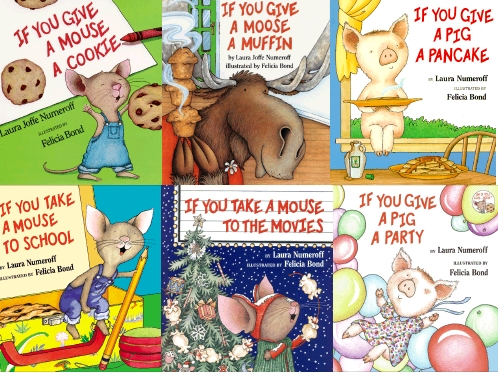
Second Grade started the school year learning about circular stories, like those written by Laura Numeroff. Side note - when did she drop Joffe from the middle? I talked about the idea of a circular story ending up right where it began and talked about how a library is like that. We check out books, enjoy them, have adventures, and then the books (fingers crossed) end up in the library, right where they began. Students then created class book pages for a book titled "If You Give a Kid a Book" to review book care and library manners. We used a Google Docs presentation to create each page and I typed the student's words using a wireless keyboard connected to our smartboard computer. Similar to the Language Experience Approach, typing student's word on the big screen gives them an opportunity to see their words recorded and keeps students engaged in what is happening with whole group instruction.

Sunday, September 12, 2010
Word Up
4th and 5th Graders have Summer Reading. As a way to review what books kids read, each class did two activities, each catered to that grades list. For the first activity, we did a circle and each student told the class his/her favorite summer reading book from the list. At the same time, I typed the book titles into a list on a word document. Then, we copied and pasted the list into Wordle. And, voila!

Following the circle and wordle creation lesson, students also created a scavenger hunt that included finding students who had read certain books, the authors of certain books, or the names of characters from those books. The students seemed engaged and voted to continue the activity during the next class period to have more time to complete as many boxes as possible.
I plan to create a bulletin board to showcase the wordle that each class created. Pretty neat summary activity for summer reading!
Subscribe to:
Posts (Atom)