Friday, September 9, 2011

Friday Tech Tips for Teachers: Wordle

At our first faculty meeting, our assistant principal demonstrated to teachers and staff how to make a wordle. We conducted a staff circle, stating one word that summed up Pine Road. Not surprisingly, caring was the word that ended up taking top billing. When creating a wordle, a list of words is input, or a famous speech, or, well, just about anything with words. If you would like two or more words to stay together, they can be joined with a tilde (~). An example of this might be the title of a book. In fact, I will illustrate that example shortly. Common words or articles are left out when calculating the most frequent word. So the, a, an, and, or of would not end up being the biggest fish in the sea. Wordle represents words by size. So, whatever word is in the list, or speech, or text most often will end up in the largest font size. Different color schemes and even custom color schemes can be chosen. You can randomize text to try out different fonts and colors. When you are finished, you can choose to post your wordle to a public gallery. Wordle is quite popular, so don't expect yours to stay on the front page for too long. Copy the HTML code to embed your wordle in a webpage or blog so that it will link back to the original or print it out to keep a copy.

In the library, we created Summer Reading wordles with each class in grades 3-5 as an opening circle activity. Last year, most students had read from a prescribed summer reading list, but this past summer we tried something different. Students were able to read any book at all. It's interesting to see which books, characters, and series rise to the top, even without a list. It's also helpful to me to create a consideration list of books students are mentioning that we do not (yet) have in our library. Wordles are being created for each class and then I plan to compile lists for each grade and then a combined list for all the upper grades in our school.

Wordle: 3A Summer Reading

What are some other ways teachers can use wordless in the classroom:
  • Surveys (if you would make a graph, you can make a wordle)
  • Feelings

Wordle: Feeling Survey

  • Favorite color

Wordle: Colors

  • Mode of transportation to school

Wordle: Transportation

  • Famous speeches, songs, passages from a book, and students' own writing can take on a new form.
  • Take a political figure's speech, put it in a wordle and see what they are REALLY saying.

Wordle: Obama Inaugural Speech

  • In music class, import the lyrics to a song and see if students can identify the song based on the wordle.

Wordle: The Wheels on the Bus

Can you guess?

  • Ask students to create poetry with words and create a visual representation. They can repeat the words they want to emphasize.

Check out wordle at http://www.wordle.net/

If wordle has you wondering, check out tagxedo for more word artistry using specific shapes.


What ideas do you have for incorporating wordle or tagxedo into your teaching?  Share in a comment below.

Thursday, September 8, 2011

Book, Book, Book

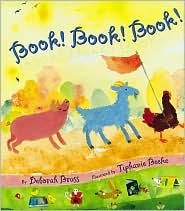
In the book, "Book, Book, Book" by Deborah Bruss, the farm animals find themselves bored when the children return to the school in the fall and find their way to the library. Each animal goes into the library to ask the librarian for help, but only one communicates successfully. I think this is a great book to use to introduce kindergarten students to the school library. We see the librarian at the circulation desk, engaged in story time, shelving books, and helping patrons. We can also notice that the books are arranged in alphabetical order. I also use this book to introduce a few things. When I meet students at the door, I tell them there will be a duck in our story, and that we are going to practice walking like ducklings. How do ducks walk? Do they all walk in different directions or in a line? So, we walk in a line to the story tower and talk about our favorite animals and some of the animals we predict will be in the story. Following this story, I also introduce a procedure for our tables. Each table has a picture of a different farm animal. I have cards with matching pictures and distribute them to students. This is how students find their tables. In the beginning of the year, I call one table at a time to find books and check out. One table at a time is called to line up as well. I could sing "Old MacDonald Had A Farm," but instead I sing "Mrs. Zschunke Had A Library" using the animals to call each table, which works on listening skills while reinforcing a familiar tune and ties into our theme as well. Throughout the year, as we change our focus from library procedures to nursery rhymes and familiar folk tales in kindergarten, the pictures and table assignments change to correspond. Hopefully other school librarians can find these ideas helpful in their library. It is important for our youngest students to have consistent routines to rely on when they come to the school library in order to have a positive experience and meet the school librarian's behavior expectations as well.

Wednesday, September 7, 2011

Restorative Practices and Circles in the Library

Our school is a Restorative Practices school. Part of what we do to address behavior and classroom management proactively is to conduct circles on a regular basis. As a teacher in the school library, I see each class every six days. It can be difficult, at times, to make time for these circles, but I have seen great benefits and opportunities to incorporate circles into the lessons I teach, giving each student the opportunity to contribute to the conversation in a controlled environment.

A talking piec is used and passed around the circle in one direction. Each student responds to a given prompt. For example, during this first cycle, we are using the following prompts:

Kindergarten: One of your favorite animals (Book, Book, Book features farm animals)
First Grade: What are you curious about in the library? (Curious George in the Library)
Second Grade: Library Expectations
Third - Fifth Grade: A book they read this summer or are looking forward to reading

In this way, I get to know the students and they get to know each other. Circles are a great way to break the ice, get students settled, and ready to learn.

Tuesday, September 6, 2011

First Day of School Jitters

Today is the first day of school at Pine Road. Each year there are jitters for students, teachers, and parents alike. Last year was my first year teaching classes in the library setting. I had taught for years prior in both first grade and kindergarten. But teaching in the library is a different animal. Many people asked me if I liked teaching in the library more, if it was "easier", or if I missed the classroom. I can say with absolute certainty that being a school library media specialist is definitely not easier. But it is different. There are different responsibilities and learning a new role is never easy. But I am not complaining because I love it. I LOVE teaching in the library, getting to see EVERY kid in the school, and watching their eyes light up when they find a "just right" book. I love helping kids learn to search in a way that is safe and effective, and learn to give credit where credit is due. I love helping students find creative ways to express themselves. I love connecting with and supporting staff in their different curricular areas, class research projects, read-aloud needs, unit development, and technology integration. Our library is not just a library. It is a media center, a living, breathing place. It is growing and changing as technology and the way we as a society embrace new ways of reading evolve. The library media center is alive. Alive with learning! Can you tell I'm passionate about my job? So, do I miss the classroom? Do I like teaching in the library more? All of the above. I miss the classroom, but I feel like teaching in the library is, for me, the best of both worlds. It's not for everyone, but it's "just right" for me!

And, First Day Jitters by Julie Danneberg is a great read aloud for teachers on the first day!


So, this year, as students enter the hallways, classrooms, and library of our school, I have jitters, but mostly the excited ones. I'm excited to share some awesome lessons, books, and technology with students this year. And I'm excited to share what we do with all of you. Thank you for joining me on the journey this year.

Monday, September 5, 2011

Extra Credit

As I mentioned yesterday, I recently finished "Extra Credit" by Andrew Clements. I loved SO many things about this book. Where to begin...

Teachers or school librarians can use this book to introduce a letter writing unit, either around the world or close to home, or a letter writing project to a character or an author. Another great book for author letter writing is Beverly Cleary's "Dear Mr. Henshaw."

Abby, the character who lives in America, loves to rock climb on the climbing wall in the gym at her school. We recently got a climbing wall at our school. It is not 30 feet tall like the wall at Baldridge Elementary School, but the kids here seem to like it just the same. My husband helped our physical education teacher set up the wall as he works at Doylestown Rock Gym and loves to climb himself. So, kids who enjoy or are interested in climbing will like to read why Abby chose to write to a student in Afghanistannimstead of one of the other two countries that were possible choices, how climbing makes her feel, and the technicalities of some of the knots and the names of different pieces of gear needed for climbing.


Anyone with an interest in current events will love this book as well. Details of some of the past conflicts in Sadeed's village are well constructed for middle grade readers. And events are portrayed realistically regarding how people in Afghanistan and in Illinois might feel about these two students writing to each other. Cultural norms are seamlessly woven into the writing to give both perspectives for each country.

Anyone who read Greg Mortenson's Three Cups of Tea, Stones into Schools, or Listen to the Wind will appreciate Clements' ability to tell a tale of education across the globe in Afghanistan and right here in the US. The similarities and differences are striking.

The growth of the characters is profound and the power of a pen pal is well portrayed.

I've enjoyed reading everything Andrew Clements has written that resides in our school library. Now it's on to what we don't have...yet. School Story, Janitor's Boy, and his newest book, Troublemaker, will be coming up on the blog soon.

Sunday, September 4, 2011

Extra Books in Extra Credit

I recently finished reading Andrew Clement's "Extra Credit". As I have recently gotten into the habit of noting other books that are mentioned, I'd like to do that for this book as well. The main characters, Abby and Sadeed, both share a love of "Frog and Toad Are Friends.". Beyond that, we learn that Sadeed has read a few other books written in English with Christian characters, opening his mind to the Western world, "books that were not on the approved list from the Ministry of Education."

The books he mentions are:
* Robinson Carusoe
* The Adventures of Robin Hood
* Hatchet
* Kim

Readers may want to read in the footsteps of a character by checking these books out themselves, or a teacher might make an extra credit bulletin board showcasing these books. Either way, hearing a book character talk about how he felt while reading a book can hook others for that book. And realizing that a student in a country like Afghanistan might have such limited access to reading for pleasure can help our students develop a greater appreciation for their library and the access they have to its books and other materials. For teachers interested in reading aloud the excerpt that speaks to the books Sadeed's teacher, Mahmood, provided, check out pages 122-123 in "Extra Credit" by Andrew Clements.

Thursday, September 1, 2011

Iza Trapani

When I was a babysitter, in high school, one of my favorite books to read at bedtime was "The Itsy Bitsy Spider" by Iza Trapani. The additional verses coupled with whimsical illustrations make for a great picture book. Many of Trapani's books have a dust jacket overlay that adds to the cover art. The Itsy Bitsy Spider's dust jacket includes a spider web. At the time, that was Trapani's only book with which I was familiar. Fortunately, that is no longer true.


In college, I had the opportunity to go to the NAEYC conference in New York and presenting and signing was Iza Trapani. There I was able to get several more, including Row, Row, Row Your Boat, and Baa, Baa, Black Sheep. Iza Trapani was an excellent presenter, explaining her methods and connecting to her audience.

More recently, I picked up a few more of Iza Trapani's books at the library. I can see these fitting in well to our kindergarten library curriculum. Last year, we did a unit on nursery rhymes, and many of Iza Trapani's books are extensions of familiar nursery rhymes with inventive verse added on to the original. The ones we have been reading at bedtime these days are "Where, Oh Where Has My Little Dog Gone," and "Mary Had a Little Lamb."

Cecelia has enjoyed both, and I'm certain that this year's kindergarteners will too!