Wednesday, October 30, 2013

10 Plants that Shook the World


Wondering what the 10 plants are?  

Spoiler alert!  Drumroll...

1) Papyrus
2) Pepper
3) Tea
4) Sugarcane
5) Cotton
6) Cacao
7) Cinchona
8) Rubber
9) Potato
10) Corn 

In reading about each of these world shaking plants, it occurred to me that early civilizations were really onto something.  I am also writing this post on Columbus Day though it won't post until later, and though I'm not at all a fan of his methodology, it makes me think of Chris and all those other explorers of the late 1400's and their shock at early cultures valuing plants or spices in higher regard than...gold.  But the joke's on the explorers because once you have gold, you use it to get...your hands on those super valuable plants and spices.  Am I right?

Author Gillian Richardson does an awesome job of engaging readers with fun factoids, history, and even present day anecdotes as well as frame of reference for the impact we have on the growing climate for many of these plants and conservation as well.  

Artist, Kim Rosen, has a unique style that lends itself to creating artwork to complement the Richardson's text.

One more spoiler - herbal tea does NOT contain tea.  Who knew?

Reading about wars waged for control of supply and supply routes of many of these natural resources made me think of the present day situation we find ourselves in waging wars or...conflicts to protect what seems to always end up being countries that are situated with vast access to oil.  Coincidence?  I think not.

Likewise, for the first time, Great Britain's land grabs and colonization efforts made sense to me for the first time.  Again, not that I agree with the methods.  At all.  But it made sense.  They needed tropical lands to grow plants in the "right" climate in order to control the supply chain.  The Revolutionary War and the dumping of ALL that tea in the Boston Harbor must have REALLY ticked them off.  Just saying.

And the revelation that potatoes did not originate in Ireland was an eye opener for me.

I do so love to learn and 10 Plants that Shook the World kept me engaged and wanting to read more.  Kudos to Richardson and Rosen!

10 Plants that Shook the World
ISBN: 968-1-55451-445-8
Published 2013 by Annick Press
I borrowed this copy from my public library to read and review.

Tuesday, October 29, 2013

The Tapir Scientist


Sy Montgomery and Nic Bishop are a super team when it comes to collaborating on "Scientists in the Field" type books.  Following in the footsteps of:

  • Kakapo Rescue: Saving the World's Strangest Parrot
  • Saving the Ghost of the Mountain: An Expedition Among Snow Leopards in Mongolia
  • Quest for the Tree Kangaroo: An Expedition to the Cloud Forest of New Guinea
  • The Tapir Scientist: Saving South America's Largest Mammal 
Takes the reader to an exotic destination, The Pantanal.

Quite frankly, just writing out that list of amazing nonfiction titles makes me want to be in on this "Scientists in the Field" writing team. Traveling to New Zealand, Mongolia, New Guinea and now South America for "work" doesn't sound too bad to me.  Having wild animals still roaming from prehistoric times named after you (spoiler alert), also not too shabby.

In Tapir Scientist, Sy Montgomery captures the daily trials and successes of Pati Medici and her tapir team.  Nic Bishop's photography helps the reader to feel as if they are there.  The photographs capture the landscape of the Patanal and the diverse population of wildlife besides the tapirs that are found there.  In addition to learning more (much more than I had known before) about tapirs, I learned how to properly pronounce their name.  I never thought to question my pronunciation before, pronouncing it tuh-peer when in fact, it should be pronounced tay-peer.  Good to know.  I liked reading about the length to which the veterinarians and scientists go to not stress out the animals when they are trying to collect data or radio collar the tapirs.  Interesting too was Gabriel's, the master marksman's, backstory of learning to hunt and not liking the feeling of hunting a creature, so he turned his skill to a good cause of helping to learn more about the animals and hopefully justify further conservation of their land by helping to sedate them from afar by a dart instead of having them caught in traps which can cause higher anxiety.

Tapirs are such interesting looking creatures.  So cool that they have remained unchanged since the Miocene period.  They must be doing something right if evolution hasn't touched them!  Likewise, Sy Montgomery and Nic Bishop have also been doing something right to create such awesome nonfiction reads that take the reader to places they might not otherwise encounter.  Although, evidently we are all welcome to stay at the ranch.  I'm booking my flight there now.  Check it out: Baia das Pedras

The Tapir Scientist
ISBN: 978-0-547-81548-0
Published 2013 by Houghton Mifflin Books for Children
I borrowed this copy from my public library to read and review.
Monday, October 28, 2013

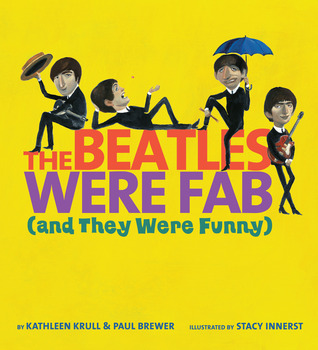
The Beatles Were Fab (and They Were Funny)


The Beatles were (and their music still is) fab.  Reading about their instrument choices on page one made me wonder.  What if Paul continued to play the trumpet instead of the guitar?  Could have been a whole different music scene!

Stacy Innerst's illustrations are perfect for this book.  The caricature-esque style of the Fab Four on the cover and the picture of Ed Sullivan capture the moment.  The end papers with jelly beans remind us that jelly beans are harder than "jelly babies" and hurt when thrown.  I love the guitar roller coaster image as well as the speech bubbles to show the joking nature of their interviews.  

Kathleen Krull and Paul Brewer show how Beatlemania got dangerous and ended when the Beatles got to the "Toppermost".  This book is tops too, just like the music of the Beatles.


The Beatles Were Fab (and They Were Funny)
ISBN: 978-0-547-50991-4
Published 2013 by Harcourt Children's Books
I borrowed this copy from my public library to read and review.

Sunday, October 27, 2013

My First Day


So, I had a baby.  And before I had that baby, I visited the library to stock up on books to read while I was (inevitably) feeding that baby and staying up late at night to do so.  One of the books I picked up was “My First Day.”  Thinking it would be a sweet book to read to my sweet baby boy on his “First Day.”  And it was. 

Fast forward three months and I was delighted to see “My First Day” on my Elementary/Middle Grade Nonfiction nominee list for the CYBILS. 

Steve Jenkins and Robin Page bring to life the first days of 22 very interesting animals.  Each animal is labeled with its name and illustrated in Jenkins’ unique and endearing style.  Children (and their parents/teachers/older readers) will learn some fun new facts about little ones in the wild.

Did you know a zebra mother will memorize her young’s pattern of stripes and would be able to find baby among the thousands of zebras in a herd?

In the end matter, there is a paragraph about each animal highlighted throughout the book with information about the size, location, diet, and interesting facts. 

“My First Day” is a great introduction to many different rare animals and their baby behavior.  It makes for a great read aloud or bedtime book for young readers or independent readers.  I can see many young readers searching for more nonfiction books about some of the animals featured in “My First Day.”  Speaking for myself, I’d like to read more about

My First Day
ISBN: 978-0-547-73851-2
Published 2013 by Houghton Mifflin Books for Children
I borrowed this copy from my public library to read and review.

Saturday, October 26, 2013

Flying Solo: How Ruth Elder Soared into America's Heart


We all know Amelia Earhart as the first woman to fly across the Atlantic Ocean and later went famously missing.  One of our true mysteries. 

But, she wasn’t the first woman to attempt to fly across the Atlantic.  Ruth Elder didn’t let the fact that she was a beauty queen define her entirely.  Though, it didn’t hurt.  Flying Solo: How Ruth Elder Soared into America’s Heart by Julie Cummins and illustrated by Malene R. Laugesen is the story of Ruth’s first flight highlighting that fact that she didn’t make it across the Atlantic.  It also highlighted her ingenuity in staying alive and seeking rescue with the help of a ship, its captain and crew.  Ruth was still lauded upon her arrival in Europe. 

Even more fascinating to me was the cross-country all female plane race which took place in 1929.  Navigation meant following road maps, literally looking down at the roads below to know in which direction to fly.  In the favorite story from the derby, Ruth’s maps flew out of her plane and she landed to get her bearings.  In an instance like this, I wondered: Would a man have stopped to ask for directions? 

I love a good author’s note.  This one starts out: “It’s hard to imagine a time when American women didn’t have the choices or freedoms that we do today.”  On this point, I disagree.  It’s not hard to imagine at all.  I’m glad that women have come such a long way in gaining equal rights, but it was one hurdle after another.  “Flying Solo” tells an important story, putting faces on the fight for women’s rights in America.  The illustrations are well paired to the story.  I especially enjoyed the interspersed newspaper front pages with information about Charles Lindbergh’s solo flight across the Atlantic and Ruth Elder’s crash and rescue in the Atlantic.  The marquee on the title page and framing of the text were reminiscent of the timeframe of the story in the late 1920’s. 

The author’s dedication: To the young women who see the horizon of their dreams and soar toward it – fly, girls, fly!  - J.C.

Flying Solo: How Ruth Elder Soared into America’s Heart
ISBN: 978-1-59643-509-4
Published 2013 by Roaring Brook Press
I borrowed this copy from my public library to read and review.

Friday, October 25, 2013

Miss Moore Thought Otherwise: How Anne Carroll Moore Created Librariesfor Children

 
I LOVE that Anne Carroll Moore advocated for children of the day and their rights to access the library.  Through her groundbreaking work, libraries more often than not have children's sections with age appropriate materials.  These areas lay the groundwork for young children to become lifelong library patrons with fond memories of what a library has to offer.  I may be partial (being a school librarian) but I really do LOVE this story and the way it is presented from Annie's own childhood up through her ability to travel the country teaching others how to create welcoming spaces for children. 
 
Perhaps my favorite illustration is the removal of the "SILENCE" sign from above the circulation desk.  It is astonishing to me how many people think libraries still should be silent at all times.  Granted, having quiet space is important, but having space to explore, collaborate, and read aloud is equally important.  The color palette of illustrations is bright and cheerful, as is the idea of children's areas in libraries.  Debby Atwell does a lovely job of incorporating variety in her color scheme.  The backdrop of the marble face of the New York Public Library helps to enhance the bright colors used for clothing and the multicultural facet that including bringing children together from all of New York's diverse neighborhoods and giving those children amazing opportunities to interact with famous authors, illustrators, and dignitaries of the day.
 
Jan Pinborough is a debut author - amazing!  In this, her first children's book, she incorporates the phrase "Miss Moore thought otherwise (Annie when she was younger)" as a refrain to show how she did things differently than other people of the time.  The title/refrain really ties the ideas of the story together well. 
 
ISBN: 978-0-547-47105-1
Published 2013 by Houghton Mifflin Books for Children
I borrowed this copy from the public library to read and review.

Thursday, October 24, 2013

On a Beam of Light


As the author, Jennifer Berne, states in her author's note, there are hundreds of books written about Albert Einstein and she read more than 50 of them.  In "On a Beam of Light" she presented information about Einstein in such a way that my 4 year old daughter asked to read it twice at bedtime tonight.  That is an achievement in and of itself.  And telling that such a young child was engrossed by his story.  I've seen images of his messy workplace before stating it was the workplace of a genius to justify colleague's desks and those of students, but I hadn't known before that Einstein was a late talker.  Makes sense that he was, perhaps, absorbing the natural world around him.  My daughter asked what the word behaved meant and I tried to explain that the teachers didn't think he was being "good" because he was asking so many questions but that we know questions are good.  And that it's not always good to act the same as everyone else.  Reading the story to her helped me to see and hear it from her perspective.  Hopefully, she will recognize the genius of wondering, thinking, and imagining.

Vladimir Radunsky's illustrations felt playful to me and as I read more of Berne's author's note, that seemed very fitting as Einstein was playful as well.

On a Beam of Light: A Story of Albert Einstein
ISBN: 978-0-8118-7235-5
Published 2013 by Chronicle Books
I borrowed this copy from my public library to read and review.