Showing posts with label nfpb. Show all posts

Thursday, February 28, 2013

CYBILS #winning


So, after the first round shortlist for the Nonfiction Picture Book category was announced on New Years Day, I was told I could "lift the curtain" and discuss some of the process, my favorites, etc.  And I meant to do that.  Well, sort of.  I really did mean to do that.  But February was a bit of a hectic month, and so, January was a bit of a hectic month just thinking about February, and tomorrow is Read Across America, which made things feel like they never stopped being hectic and, therefore, blogging was put on the back burner.  Enough excuses.  For entirely different reasons, I have a smidge of time to blog today.  And, as far as CYBILS are concerned, reason to gloat!  So, I shall give you a look at the great and powerful CYBILS and what I have learned this year.


1) When they say it's a lot of work, that's no joke.  I read a LOT of books.  Lucky for me though, I really, really like to read lots of books.  And, it was a professional opportunity to familiarize myself with a number of awesome authors and illustrators and their newest work.  Which, in turn, made me research some of their older work as well.

2) I had no idea what the expectations were...but now I do.  When they say shortlist, they mean shortlist.  There was some confusion on my part where at one point, I thought we, as a panel, were trimming things down to a list of 30.  Which (I thought) compared to 100, was pretty short.  But no, a shortlist is 5-7 books.  Which meant many, many of my contenders had to be dismissed.  Sigh.

3) I had no idea what the timelines were.  Now I do.  First round shortlists are announced on New Years Day and winners are announced on Valentine's Day.  I mean.  Could they make it any easier to remember that?  Now I know.

4) I thought I had to blog about every book.  I started to, but if I had continued to, I wouldn't have had time to read every book.  Reading trumps blogging.  As it should.  Clearly.

So, on to deliberations.  I purposefully did not look at any other panelists short lists as I was building my own.  I didn't want any biases to creep in prior to discussion of the books.  So, I read, and I blogged, and I added books to my personal shortlist that I thought stood head and shoulders above the rest.  Our short lists were to include 10 books and we were allowed an additional 5 in reserves.  After reading 100 awesome books, that was a tricky feat.  I loved many more than appeared on my short list. Here is my short list, in no particular order:


Now, back to deliberations.  I was told that my list was the most "unique".  Of the ten titles on my shortlist, six of those titles did not appear on any other panelists list.  SIX.  The remaining four only appeared on one other panelist's shortlist.  Meaning, most people did not agree with my choices.  Well, that is why a panel is a panel, right?  Lots of different opinions.  Healthy discussion.  But, I felt like I was either on the wrong track, or going to hold things up unnecessarily.  I felt sort of bad.  But...I also felt strongly about the titles I had selected.  I had my reasons.  And I was ready to bring those reasons to the table.  So, I did.

And I'm glad that I did.  With any deliberations, there is some give and take.  If you are familiar with this year's finalists, you'll realize only one of my titles from above made it to the short, shortlist.  And, with that give and take, one title made it to that finalist short list that I disagreed with wholeheartedly, and wasn't afraid to let anyone know how much I disliked it.  One of my fellow panelists insinuated that I didn't dislike it that much...but I did.  I was just kinder in my blog post because I'm all for encouraging reading, even if it's not my favorite.  But...I trusted that the final panel would see reason.  And..they did.  The one title I fought for hardest was the one I "blurbed" on the finalist post: Mrs. Harkness and the Panda.  And...it WON!!!!!

That's me with ALL of the books our library received from my participation on the CYBILS NFPB first round panel.  All catalogued and ready for kids!  Featuring (of course) Mrs. H. and the Panda.

So, Valentine's Day was extra sweet for me this year.  I felt a little like Colby Sharp after The One and Only Ivan won the Newbery Medal.  Though, he did a much better job than I of backing his horse in that race and letting the world know how he felt about.  But, I got my horse in the race.  And, that's a start.

I hope to be involved in the CYBILS on a panel again next year.  Maybe NFPB, maybe something else.  I'm looking forward to diversifying my reading and, in the meantime, reading and blogging about some 2013 titles now to save some time come fall. 


Wednesday, December 5, 2012

The Elephant From Baghdad


The Elephant from Baghdad is written by Mary Tavener Holmes and John Harris and illustrated by Jon Cannell.  The story itself, of Charlemagne being gifted an albino elephant from Harun al-Rashid, caliph of Baghdad, is FASCINATING.  The journeys that the ambassadors made, on FOOT, from present day Germany to Baghdad was long and arduous.  I can only imagine the return trip with…an elephant.  I think I would be pretty concerned that the ginormous clock would fall off the elephant’s back.  Just me?  I believe it is all true as transcribed by Notker the Stammerer.  He even says, “But it is true.  I swear it.”  I like that photographs of real artifacts were interspersed with Cannell’s illustrations.  The story telling from Notker the Stammerer’s point of view was well done, realistic and also showed that it was the monks of the time who recorded history and so, it was from their point of view that accounts came to be known to others. 

The Elephant From Baghdad
ISBN: 978-0-7614-6111-1
Published 2012 by Marshall Cavendish Children
I borrowed this copy from my public library to read and review.
Just today, I received a review copy from the publisher for CYBILS.


Here Come the Girl Scouts!


Here Come the Girl Scouts by Shana Corey and illustrated by Hadley Hooper has gump-shun, just like Juliette "Daisy" Gordon Low.  While I was a girl scout myself, I never knew the story of Juliette Gordon Low.  In fact, I didn't know who the founder of the girl scouts was.  Last year marked the 100th anniversary of the girl scouts and as such, many of my students participated in celebrations surrounding the centennial of the Girl Scouts and celebrating its founding leader, Juliette Gordon Low.  As a result, more than one of my third graders were asking for books on Juliette Gordon Low when they began their wax museum biography assignment.  To which I replied...who?  I promptly got materials from the public library to fill the gap that existed in our school library at the time.  And, now, after reading this picture book biography of Juliette Gordon Low, I can understand the fascination with her.  From childhood on, Juliette or Daisy (as I will now refer to her as because I'm getting tired of typing out Juliette Gordon Low...), so Daisy was different.  She'd actually fit in quite well 100 years later (I think), but maybe because she changed the way the world looks at girls.  She changed the way girls look at the world.  Daisy was truly ahead of her time, recognizing the importance of conservation, the importance of building confident young females, the importance of acceptance and understanding.  She was my kinda gal!

Some things I wish I'd learned as a girl scout:
  • How to secure a burglar with eight inches of cord (because, you know what I always have on hand...eight inches of cord!)
  • How to stop a runaway horse (what did they do??)
  • How to get the skin off a sardine (are you supposed to?)
  • How to brush your teeth if a crocodile takes your toothbrush (IF?  I think you might have bigger problems in this situation...)
And badges I wish had existed:
  • Dairy Maid 
  • Interpreter
  • Flyer
  My favorite element are the quotes from the first Girl Scout Handbook throughout the story.  "Every little girl...goes to make up some part or parcel of our great whole nation."  

Here Come the Girl Scouts!
ISBN: 978-0-545-34278-0
Published 2012 by Scholastic Press
I borrowed this copy from the library to read and review.
I plan to add this book to our school library collection.

If You Lived Here


If You Lived Here…You’d already be home.  Each time I looked at this book, that is what I thought.  And yet, not one of these homes reflected my own.  I’d love to see each of them up close and some I have in my travels.  I’ve seen a Greek island village as pictured on the cover, and I’ve seen the canals of Venice and the homes that exist there.  Others I’ve seen in movies, but I welcomed this unique opportunity to learn details of how they came to look the way they do and why.  I never pictured a log cabin as being two separate spaces.  With the explanation that trees taller than 16 feet were tough to find, it makes perfect sense.   Many homes had features designed for protection from outside intruders.  Adobe homes had ladders that could be pulled up and inside so that intruders could not get inside.  It’s a wonder though that invaders didn’t start carrying ladders with them.  Where there’s a will.  Drawbridges used to access, or drawn up to not access do provide quite the barrier to entering a French chateau.  Protection isn’t always from outsiders, though the design of a Chinese Fujian tulou does look to present quite an obstacle with its high walls.  Natural elements, such as earthquakes also need to be considered, especially depending on your location and the likelihood of such events.  The Fujian tulou is designed to withstand the impact of an earthquake with walls that thin out at the ground level and curve.  Back to intruders, “white towns” found on many Greek islands through the Aegean Sea had streets throughout the village that were laid out like a maze, intentionally, to trick invaders and make them get lost once on land.  Overall, each of the homes featured in “If You Lived Here” was fascinating and the illustrations which were also created by author Giles LaRoche appear to have painstaking detail.  The style of bas-relief paper cut collage is such an intricate process to create each of these homes.  I am interested to check out LaRoche’s other work as well.  


If You Lived Here
ISBN: 978-0-547-23892-0
Published 2011 by Houghton Mifflin Books for Children
I borrowed this copy from the public library to review.
After reading and reviewing, I also received a review copy from the publisher specifically for the CYBILS.

Tuesday, November 13, 2012

Follow the Drinking Gourd


Follow the Drinking Gourd as retold by Cari Meister and illustrated by Robert Squier

Follow the Drinking Gourd is published by an imprint of Capstone, so it is no surprise that the illustrations have a graphic feel to them.  Though many books for children have been published about the underground railroad and different methods of communicating its route, I had not heard of the "Drinking Gourd" before.  I looked up a video to hear the song, to feel its words and the power, and I can only imagine the captive audience that Peg Leg Joe must have had each night.  I wish we knew more about his story, besides his heroic journey to tell the slaves of a way North to freedom.  Meister does an excellent job of interspersing lyrics from the song within the text to bring authenticity to the story.  The inclusion of a glossary, additional reading, and additional websites for students will keep children learning more about this fascinating topic.

Follow the Drinking Gourd
ISBN: 978-1-4048-7375-9
Published 2012 by Picture Window Books
I received this copy from the publisher to review for the CYBILS.
I plan to add this review copy to our school library collection.

Looking at Lincoln


Looking at Lincoln by Maira Kalman 

I enjoyed the path of this story, of a child passing a Lincoln impersonator on the street and then digressing into the tale of his life with some meandering thoughts and opinions interspersed.  While Kalman's style of illustration isn't my favorite, I think she made some excellent choices in what she chose to portray.  A lone log cabin, a stepmother who allowed Abe to dream, a hat that held notes, a soldier's uniform with a shot through the heart.  Powerful stuff.  My favorite illustration is the one of the cherry blossoms in DC.  I have been there for their blooming and it is spectacular!  The simple spots of pink, offset by the vibrant green grass brings this page to life for me.  The topic itself, is well timed to coincide with the movie, Lincoln.  The endpapers show the text of the Gettysburg Address, highlighting specific words to bring them to the fore of our thinking, as they may have been for Lincoln himself.

Looking at Lincoln
ISBN: 978-0-399-24039-3
Published 2012 by Nancy Paulsen Books
I borrowed this copy from the public library to read and review it.

Balloons Over Broadway


Balloons Over Broadway by Melissa Sweet is already a Sibert Medal Winner and is a nominee for a CYBILs award as well.  Melissa Sweet intersperses dense text about Tony Sarg with more animated features with word bubbles that seem to pop off the page and fun fonts to show strokes of genius on the part of the puppeteer.  And, I love any book that you have to turn from landscape to portrait as Sweet does when showing the first balloon marionette, the elephant, shown high above the parade goers.  Sarg's story is an inspiration to do what you love.  A quote under the author's note reads, "I have never done a stroke of work in my life." - Tony Sarg.  Meaning (at least to my interpretation) not that he didn't "work" hard, but that he didn't consider his work...work.  It was fun!  It was what he loved to do!  Within the story, the origin of the Macy's Parade lies in the traditions of many of the immigrant workers, who were accustomed to music and dancing in the streets to celebrate the upcoming holidays.  I really like that Mr. Macy honored their tradition and in such a BIG way.  So, good readers, thing BIG and (if you haven't seen it already) check out Balloons Over Broadway.  Just in time for Thanksgiving and the parades that will be coming soon.

Balloons Over Broadway
ISBN: 978-0-329-92629-8
Published 2011 by Houghton Mifflin Books for Children
This book was already a part of our school library collection following the awarding of the Sibert Medal.

Saturday, November 10, 2012

Georgia In Hawaii


Georgia in Hawaii: When Georgia O'Keefe Painted What She Pleased written by Amy Novesky and illustrated by Yuyi Morales is a breath of fresh air with a gorgeous color palette inspired by the art of Georgia O'Keefe.  This particular story follows her journey to Hawaii to paint, as she was asked by the Hawaiian Pineapple Company, a pineapple.  The first information that really piqued my interest was the  company's refusal to allow Georgia to live near the fields as the other workers did, to observe the plant in its setting, instead of plucked.  What were they trying to hide?  Were they concerned that she might paint a less becoming scene?  She was hired as an artist for the company, but she was still an artist and refused to paint what was dictated to her.  Instead, she found plenty of inspiration in the lush Hawaiian landscape.  The fact that, in the end, Georgia gave into the company makes me sad, as a reader, and as a defiant spirit.  Yuyi Morales does a beautiful job of capturing Georgia O'Keefe's well known flowers, and specifically the flowers native to Hawaii.  Amy Novesky captures a story in a way students can understand and gives a glimpse into Georgia O'Keefe's story, leaving readers wanting even more.

Here is Georgia O'Keefe's Pineapple Bud painting as commissioned by the Hawaiian Pineapple Company


Georgia In Hawaii: When Georgia O'Keefe Painted What She Pleased
ISBN: 978-0-15-205420-5
Published 2012 by Harcourt Children's Books
I read and reviewed this copy discreetly in my local Barnes and Noble.

Friday, November 9, 2012

Mrs. Harkness and the Panda


Mrs. Harkness and the Panda is written by Alicia Potter and illustrated by Melissa Sweet.  Melissa Sweet is also notably nominated for a CYBILS for her book, "Balloons Over Broadway" which won last year's Sibert Medal.  Once again, a story unknown to me (and extremely interesting) is always going to be a favorite.  The story of Ruth Harkness and her eventual and lengthy and painstaking search for a panda, the first to be brought to the US, is in one word...incredible.  Melissa Sweet's illustrations and use of authentic material and textures from China enhance an extraordinary story.  Something that struck me about the story is the timeline itself.  Not to give too much away, but Ruth Harkness married at the age of 34, which, in 1934, I would imagine would be considered sort of old to be getting married.  She also got married to a man she'd been friends with for ten years.  A lengthy courtship.  And then, a mere 23 DAYS later, her newly wed husband left for an expedition to China and...died.  What a tragic beginning.  Now, he died 2 years later, but he was gone all that time.  So, for all intents and purposes, they were together for 23 days after being married.  Now, this is a book written for an audience of children, but I am very interested to read more about Ruth and William's courtship and marriage.  But I would imagine that is a story (literally) for a different day.  Also, looking at the handy dandy timeline, or as Alicia Potter terms it "Chronology of Events," Ruch Harkness was able to accomplish in approximately 4 months what her husband was unable to do in 2 years.  Not an explorer.  Hah!  Ruth Harkness sure did prove a few folks wrong!  And her forethought to bring a bottle to feed a baby panda.  Smart!  Now, this story is perfect for a read aloud with students.  It's engaging, but not too long, not too heavy on information.  On the same token, if a student needs enough information on Ruth Harkness to, for example, write a report, this book will not provide enough depth.  With that said, I LOVE it.  I love the illustrations, I love the story.  I love it.  And it leaves me wanting more.  And I think it will do the same for you.  Enjoy!


Mrs. Harkness and the Panda
ISBN: 978-0-375-84448-5
Published 2012 by Alfred A. Knopf
I borrowed this copy from my public library to read and review.
I plan to add this book to our school library collection.

Wednesday, October 31, 2012

Just a Second


Just a Second by Steve Jenkins

I found many of these time based factoids hard to believe.  For example:
  • A pygmy shrew's heart beats 14 times (in ONE second)
  • A black mamba slithers 24 feet (in ONE second)
When I asked my husband his guesstimation, he just made me frustrated by ridiculously over estimating.

Now, onto the notably slow creatures covering what I thought to be a lot of ground in a short time.

  • A three-toed sloth hauls itself about ten feet (in ONE minute)
  • A giant tortoise lumbers about 15 feet (in ONE minute)
And, my favorite eco-aware items:
  • Around the world, 59,000 barrels of oil are used (almost 15,000 of them in the United States) (in ONE minute)
  • People use the equivalent of 200 billion sheets of letter size paper (in ONE day)
  • Bamboo can grow 36 inches (in ONE day)
  • Human development destroys an area of forest equal in size to 550,000 football fields (in ONE week)
  • People around the world produce enough trash to fill a square pit more than one mile on a side and 1,200 feet deep (in ONE month)
  • Global warming causes a sea level rise of about 1/8 of an inch (in ONE year)
Fabulous representation of time and distance.

Just a Second
ISBN: 978-0-618-70896-3
Published 2012 by Houghton Mifflin Books for Children
I borrowed this copy from the public library to read and review.

The Beetle Book


The Beetle Book by Steve Jenkins

Double confession day, I have also not read (cover to cover)  a Steve Jenkins book, and just like Nic Bishop, he is a name, he is known, he is renowned.  I am ashamed.  But no more!

The Beetle Book details be-tails, ahem, beetles, from small to quite large, colorful to camoflauged, and very, very numerous.  "Line up every kind of plant and animal on Earth...and one of every four will be a beetle."  From Beetle overview to "Beetle bits" and the specialties of each beetle grouped by different characteristics such as "Chemical warfare" and "Battling Beetles", anyone looking for information on beetles has found a treasure trove of info with detailed illustrations by Steve Jenkins.  Since some beetles needed to be enlarged to showcase certain details, each is shown in true size in a silhouette along the bottom of the page.

The Beetle Book
ISBN: 978-0-547-68084-2
Published 2012 by Houghton Mifflin Books for Children
I borrowed this copy from the public library to read and review it.

Snakes


Snakes by Nic Bishop

I'm about to make a confession.  Are you ready?  I enjoy Nic Bishop (that's not the confession).  I think he's an incredible photographer, artist, and informational writer.  I've looked at many of his books.  I've purchased many of his books for our school library.  He's a name.  He's known.  He's renowned.  Here's the confession part.  I don't think (there I am protecting myself from perjury) that I've ever read a Nic Bishop book cover to cover.  Every word.  Beginning to end.  Now, in the wonderful world of nonfiction, you often don't need to read in a sequential order to garner information, but nonetheless, I'm embarrassed.

With all that said, CYBILS, it's a good thing you picked me, because I have been doing just that.  Reading nonfiction picture books cover to cover and loving every second (oh, wait...there's a book for that) of it.

Anyway, back to snakes.  These are not snakes on a plane.  At all.  These are not snakes in the wild (as I discovered when I read the author's note) but snakes in Nic Bishop's "snake room."  Don't you have one of those in your house?  Because of the nature of snakes: as Nic states, they "...are shy, nervous, and fast.  They do not always want to stay in one place while you take their picture.  And if a snake does not want to do something, it always gets its way."  So, he photographed them in captivity, learning at the same time how to care for them and their needs.  I also learned that Nic B. uses photoshop (or some other form of computer editing) to get the shot he wants.  Just a little tid bit.  Good to know.  Also, given the picture he doctored, he's VERY good at it.  The most remarkable photo (which was not photoshopped) was the one of an African egg eating snake eating...an egg.  You may never look at an egg the same way.  The snake's throat has special spines to crack the egg, making it possible to "slurp" the contents and spit out the empty eggshell.  That's certainly one way to get your protein.

Prior to reading this book, I was no snake expert.  I'm not the kind of girl who is afraid of snakes, per se, but I've also never been around a truly scary snake outside of an enclosed, controlled habitat.  All that to say, here are some of my favorite (new to me) fun facts:

  • Egg eating etiquette
  • Snakes can ripple muscles in their underbelly to glide forward without wriggling (while I'm sure I've seen this at some point in time, it didn't occur to me how it was happening).
  • Brumation: long, deep rest
  • Many snakes only eat 8 big meals a year

Snakes
ISBN: 978-0-545-20638-9
Published 2012 by Scholastic Nonfiction
I borrowed this copy from the public library to read and review it.
I plan to add this book to our school library collection.
It will join:
 

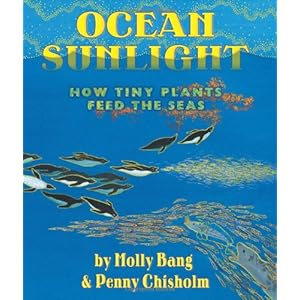
Ocean Sunlight: How Tiny Plants Feed the Seas


Ocean Sunlight: How Tiny Plants Feed the Seas
By Molly Bang and Penny Chisholm

This highly informative text is beautifully illustrated throughout.  Typically, I find that scientific processes such as photosynthesis are best represented with photographic diagrams, but Molly Bang does a great job of representing these types of processes.  This story answers a question I didn’t even realize that I had or should have had.  And one that I’m sure will interest students as well: “…where are the ocean’s green plants?:  For students using “What Smaller Than a Pygmy Shrew” in their science classes will relate to this discussion of they teeny tiny plants, phytoplankton, that you need a microscope to see.  These ideas are somewhat difficult to wrap your brain around, but the illustrations do just what they are needed to do.  They illustrate the points being expressed in each piece of text.  The probing questions throughout make me think of students saying, but wait…what about…[insert seemingly unlikely, but completely probable scenario here]?  As a result, I think students will especially enjoy the way the text moves logically from point A to point B.  The poetic text weaves from one idea to the next and the notes following the main body of text of the book explain each point in turn with more scientific detail.  This book is the third installment in a series with “My Light” and “Living Sunlight”, both of which would work well with lessons about the power we get from our sun.  Penny Chisholm seems to be the information piece of this project, where Molly Bang brings it to life with text that young students can understand and illustrations that bring each idea to life with context.  The bright colors offset the time spent in the deep, deep, deep, deep ocean.  Kudos on a job well done bringing a tricky scientific concept to life for elementary and middle school students (and teachers).

Ocean Sunlight: How Tiny Plants Feed the Seas
ISBN: 978-0-545-27322—0
Published 2012 by The Blue Sky Press
I borrowed this copy from the public library to read and review it.

A Leaf Can Be


A Leaf Can Be... by Laura Purdie Salas
Illustrations by Violeta Dabija

I am a big fan of Laura Purdie Salas’ poetry and “A Leaf Can Be” is no exception.  We have several of Laura Purdie Salas’ books of more traditional poetry collections in our library, including “And Then There Were Eight,” “Always Got My Feet,” "Do Buses Eat Kids?," "Flashy, Clashy, and Oh So Splashy," and the one the students in my school are surely most familiar with; "Tiny Dreams Sprouting Tall: Poems About the United States" (we use several of these in regular rotation on our morning show, PRTV).  I recently visited Laura Purdie Salas’ website to see if she had any new books of poetry out and found to my delight that she did.  I requested “A Leaf Can Be”  from our public library before it was posted to the CYBILS Nonfiction Picture Books Nominee list (love to be ahead of the game!).  Though I am happy it is included in our list, I was also surprised it wasn’t, by contrast, a part of the poetry list.  I have since found out that collections of poems are included in the poetry category, whereas a picture books told in poetry that also happens to be nonfiction, does fall into the NFPB category.  Genre often blurs the lines when it comes to award selection like this, but any way you slice it, I’m honored to be able to share my thoughts on “A Leaf Can Be” with all of you.

Violeta Dabija’s illustrations help to…illustrate the definitions given for what a leaf can be.  For example, “water ladle” is accompanied by a picture of an upturned leaf collecting water and a sheep drinking out of it.  “Rain stopper” shows a pair of foxes (I think) underneath of a tree protected from rain.  The text and illustrations lend themselves to introduce a unit of science, either on leaves themselves, the changing seasons, camoflauge, and more.  In the section at the end, “More About Leaves,” each of the definitions is further explained with specific examples.  Further, the Glossary defines several words for inquiring minds and a bibliography with further reading is included as well.  I enjoy this opportunity for students to view poetry as a form of reflection on scientific observation and to do so beautifully as well.

A Leaf Can Be...
ISBN: 978-0-7613-6203-6
Published: 2012 by Millbrook Press

I borrowed this copy from the public library to read and review it.
I plan to add this book to our school library collection.

Baby Flo: Florence Mills Lights Up the Stage


Baby Flo: Florence Mills Lights Up the Stage
By Alan Schroeder

The author’s note that precedes the opening text of the book on the verso piqued my interest.  Alan Schroeder indicates that for historical accuracy, Baby Flo’s debut was not in a butcher shop as portrayed in the book, but in a less savory establishment.  Hmm.  Also, the change of her last name at age four is well documented.  Schroeder writes, “Her parents presumably did not think that a black woman could make it in show business with the last name of Winfrey.”  Little did they know.

While I didn’t find myself a huge fan of the cover design and cover art (and I do generally judge a book by its cover) I was pleasantly surprised once I opened the book and perused the interior illustrations.  Looking at the faces of her parents as they realized what a talent they had on their hands, and knowing the stories of young talent in our country during current times, I wonder about their motives.  But at the same time, with a bleak future and a child just jumping at the chance to perform, I hope that they did what was right both for their daughter and their family.

The story starts out much as a tall tale might, except for that it is a true tale.  Baby Florence Mills worked her way from Goat Alley to Bijou Theatre and as she grew older, to New York and even London.  I enjoyed reading the story of Florence Mills’ early years, but appreciated the author’s note with photographs of Florence even more.  Tragically, film footage or audio recordings have not surfaced of Florence Mills remarkable performances as part of the Harlem Renaissance.

Baby Flo 
ISBN: 978-1-60060-410-2
Published 2012 by Lee and Low Books

I received a galley copy of Baby Flo from a publisher's preview event during KidLitCon.

I, Galileo


I, Galileo by Bonnie Christensen 

The first thing that caught my eye about I, Galileo was on the cover.  The title itself is spelled out in glittery, sparkly stars above the head of Galielo glimpsing the heavens through his telescope.  The endpapers include a map showing different cities in Italy that are included in the story.  An illustration of the Universe of Aristotle and Ptolemy shows what was believed to be true in 1564; that Earth was at the center of the universe followed by each of the planets out to Saturn (which does bring up the point that in 1564, Pluto was also NOT a planet…so perhaps they were on to something there) with the sun at the outer edges of the universe.  That would be mighty chilly, folks.

I, Galileo begins with Galileo near the end of his life, blind and imprisoned, on “house arrest.”  From there, Galileo tells us of his own childhood when he was the center of his parent’s universe.  His father was a musical theorist whose views challenged tradition.  His father insisted that, “A person must be allowed to ask questions and seek answers in search of truth.”  Galileo reminds me of Steve Jobs (I know this is a bit of a stretch) in that he went on to great success after not finishing a traditional education.  Galileo challenged many of Aristotle’s teachings and even proved them, but people would not agree and he became quite unpopular.  Galileo went on to Padua to continue his teaching and explorations of new ideas.  The illustrations with inset of some of Galileo’s inventions like a compass and sketches of his early telescope help the reader understand how these inventions helped the people of the time in a revolutionary way.  Through use of the telescope, Galileo was able to observe the night sky in a way no one ever had before.  Though Copernicus had proposed a sun centered universe 50 years before Galileo’s birth, he hadn’t been able to prove it.  Galileo lectured that he could prove it.  But he knew what the consequences could be for even talking about such ideas.  Imprisonment and death.  Galileo turned to reversing his telescope and created a microscope, studying much smaller objects.  Seven years later, Galileo’s friend became Pope and granted him the freedom to discuss the theory of a sun-centered universe as an idea, but not the truth.  He went on to publish a book discussing both theories on the earth’s placement in the universe, but the Pope’s advisor’s persuaded him that he was portrayed as a fool in the book.  As a result, Galileo was imprisoned for the remainder of his days and his writings were banned.  On the page with this information, there is a circular picture with Galileo in the center standing trial in Rome with a light  (the sun) shining down from the ceiling.  This page seems so symbolic with the shape of the main illustration, the sun shining, Galileo’s centrist position, and the surrounding color, like a dark night sky with broad brush strokes.  And so, the story ends as it began with Galileo as an old man in his garden under the open sky.  At the end of the book, a Chronology is included as well as an outline of Galielo’s Experiments, Inventions, Improvements, Astornomic Discoveries, a Glossary, Bibliography, and Websites to find more information.

Bonnie Christensen does an excellent job of bringing I, Galileo to life.  Her illustrations complement the text and the times it represents.


I, Galileo

ISBN: 978-0-375-86753-8
Published 2012 by Alfred A. Knopf

I borrowed this copy from my public library to read and review it.

Those Rebels, John and Tom


Those Rebels, John and Tom by Barbara Kerley
Illustrations by Edwin Fotheringham 

I had the opportunity to hear Barbara Kerley speak as a part of a panel at School Library Journal’s Leadership Summit 2012 in Philadelphia this past weekend.  She spoke passionately about the use of nonfiction picture books in this brave new world with the Common Core being implemented.  We often see nonfiction picture book biographies of individual historic figures, but rarely do we see a view comparing and contrasting our forefathers such as this one does.  As the text and illustrations demonstrate, John Addams and Thomas Jefferson were very different from the start, with their upbringing, demeanor, physicality and hobbies.  But both were patriots, with very similar goals in mind for the future of the colonies.  When John described the progress of forming a new government, he used the expression, “slow as snails.”  Not much has changed in our government’s proceedings, but in a democracy where each voice is heard, such is life.  While Thomas Jefferson was a strong writer, John Addams could compel delegates to see reason with his verbal arguments in favor of the document Tom had crafted, The Declaration of Independence.  The Author’s Note continues the conversation to show the ongoing friendship between Thomas Jefferson and John Addams including their contrasting views over slavery and differences over the size and power of government and the presidency.  Remarkably, both men died just a few hours apart on July 4th, fifty years after the Declaration was signed.  A facsimilie of the Declaration is included opposite the Author’s Note with each of the signers represented.  The source of each quotation is documented on the final page. 

Edwim Fotheringham’s illustrations in primary colors are bold throughout, and accentuate the differences between characters, the differences between England, King George, and the colonies.  One of my favorite illustrations shows John Addams being startled out of his bed as the Redcoats march below his window in an exercise.  There are also small details that may otherwise go unnoticed.  When Tom is arriving in Philadelphia, only Nay’s are being heard from Independence Hall.  As Tom and John start to reach their own agreement, the Yea’s and Nay’s are balancing out and as each man finds his strength, the Yay’s are resounding in Congress.  Barbara Kerley expressed on the panel at the SLJ Summit that she wanted students to have an example of a functional congress.  Mission accomplished!

Those Rebels, John and Tom
ISBN: 978-0-545-22268-6
Published: 2012 by Scholastic Press

I borrowed this copy from the public library to read and review it.
Review copy borrowed from the library prior to SLJ Summit where I heard Barbara Kerley speak and received a copy of the book, "Those Rebels, John and Tom."
I plan to add this book to our school library collection.

Wednesday, October 24, 2012

The Camping Trip That Changed America


Author, Illustrator pair Barb Rosenstock and Mordicai Gerstein are NOT from Philadelphia, lest you think I have some bias towards authors and illustrators from the Philadelphia area.

Have you ever visited Muir Woods? I have had the honor and pleasure of taking in those breathtaking, endless, and protected trees. I can only imagine having done so when they were surrounded entirely by wilderness as Theodore Roosevelt and John Muir himself did in this account.

During this time of global warming and a search for sustainable fuel sources, it is almost comical to think of a time when "Most people, even his [Theodore Roosevelt's] own experts, thought America had so much wilderness it couldn't ever be used up!". Clearly they hadn't heard of "The Lorax."

I am happy that John Muir was "The Lorax" of his time, speaking for the trees and spectacular open spaces. How lucky we are today that such visionaries came before us who sought to protect natural spaces for the rest of us to enjoy. And thank goodness for presidents such as Teddy Roosevelt who were open minded to ideas that preserved the greater good. Not only open, but willing to personally explore the grandeur of all our country had (and as a result now HAS) to offer.

In this account of "The Camping Trip That Changed America" when John Muir guided Theodore Roosevelt through the Yosemite wilderness to "see those trees for himself.". Gerstein's illustrations offer such versatility with facial profiles so expressive you can see the confusion on Roosevelt's face, the irritation on Muir's and the pure joy of both. I'm a big fan of books that you need to turn to show an illustration in profile (think Tops and Bottoms) and this book offers the perfect opportunity as both men stop on horseback in the Mariposa Grove among giant sequoias. The landscapes of Half Dome and El Capitan are gorgeous.

The author's note explains what is fact and what is fill in the blank fiction.

The Camping Trip that Changed America is the kind of book that can open minds to the way things could have been, the way they are and the way they can be in the future. Which path will our students choose for the future of our country?

The Camping Trip that Changed America
ISBN: 978-0-8037-3710-5
Published 2012 by Dial Books for Young Readers
I borrowed this copy from my public library to read and review it.
I plan to add this book to our school library collection.

Paiute Princess


Paiute Princess: The Story of Sarah Winnemucca is a tale I hadn't heard before. Which instantly made it one I would read to the end. Interwoven in the tale of her life were excerpts from her speaking engagements delineated in italics. Most of us have heard of Pocohontas and Sacagawea, but never Sarah Winnemucca, Thocmetony. Her grandfather, Chief Truckee, made peaceful contact with white men early on during the gold rush years in Nevada. An explorer he encountered, John Charles Fremont, gave "Captain Truckee" a "rag friend". This was what Chief Truckee called the piece of paper that he showed other white men written by Fremont to explain to others that Truckee was a friend. Sarah's grandfather understood the power of the written word to communicate powerful ideas. This one piece of paper changed the course for the Paiute people and Sarah Winnemucca in particular. Her grandfather valued her education and recognized her talent for understanding other languages, including English and Spanish. He encouraged her to learn and embrace white culture. Which she did. But she also recognized the value of retaining her own people's culture and tradition during a time when they were being "civilized" by settlers. She recognized the injustices of the reservation system. She wrote letters to government officials, newspapers, and the army. She had a speaking tour that lasted four years, explaining the plight of her people to sold out crowds across the country. Her written word, her spoken word, the power of her communication on behalf of her people was more than her grandfather could ever have predicted.

Deborah Kogan Ray (who lives outside Philadelphia...are you even surprised at this point?) did a masterful job of bringing this story to life both in words and pictures. The color palette matches that of the western landscape of the time. The depiction of the girls being buried beneath sage brush to hide from settlers was stark and unsettling in a most meaningful way. Following a book like "Little Dog Lost," the text seemed dense, but for a topic so new to many, that also seems necessary.

Paiute Princes: The Story of Sarah Winnemucca
ISBN: 978-0-374-39897-2
Published 2012 by Francis Foster Books
I borrowed this copy from my public library to read and review it.
I plan to add this book to our school library collection.

Little Dog Lost


It is refreshing in the world of nonfiction picture books to find one that would make a great read aloud and lesson introduction for our youngest readers. Little Dog Lost: The True Story of a Brave Dog Named Baltic is just that. With highly selective and predictable (in a good way) text, follows the story of Baltic as he is first spotted on an ice floe in the river and travels along where he is finally rescued by the crew of a ship. The final page has more detailed information of Baltic's rescue. The end papers include a map illustration of Baltic's journey and rescue. The illustrations throughout are inviting and sweet. Author and illustrator Monica Carnesi is currently local to Philadelphia. I'm seeing a pattern here...


Little Dog Lost
ISBN: 978-0-399-25666-0
Published 2012 by Nancy Paulsen Books
I borrowed this copy from my public library to read and review it.